When it comes to managing household wastewater in rural or off-grid homes, it is essential to understand the difference between a septic tank and a leach field. These two components are the backbone of any functional septic system.
The septic tank handles the first stage of treatment, where solids settle, grease rises, and bacteria start breaking down waste. But that’s only half the job. The leach field (also called a drain field) quietly handles the rest, filtering and dispersing the liquid effluent safely into the soil.
In this guide, we’ll break down exactly how these systems function, why both are necessary, and what sets them apart in terms of purpose, design, maintenance, and lifespan.
You’ll get real-world insights into what can go wrong, how to maintain your system properly, and whether it’s even possible to have one without the other.
We promise that by the end of this article, you won’t just know the difference between a septic tank and a leach field. Therefore, let’s get started!
Septic Tank – The Primary Treatment Unit
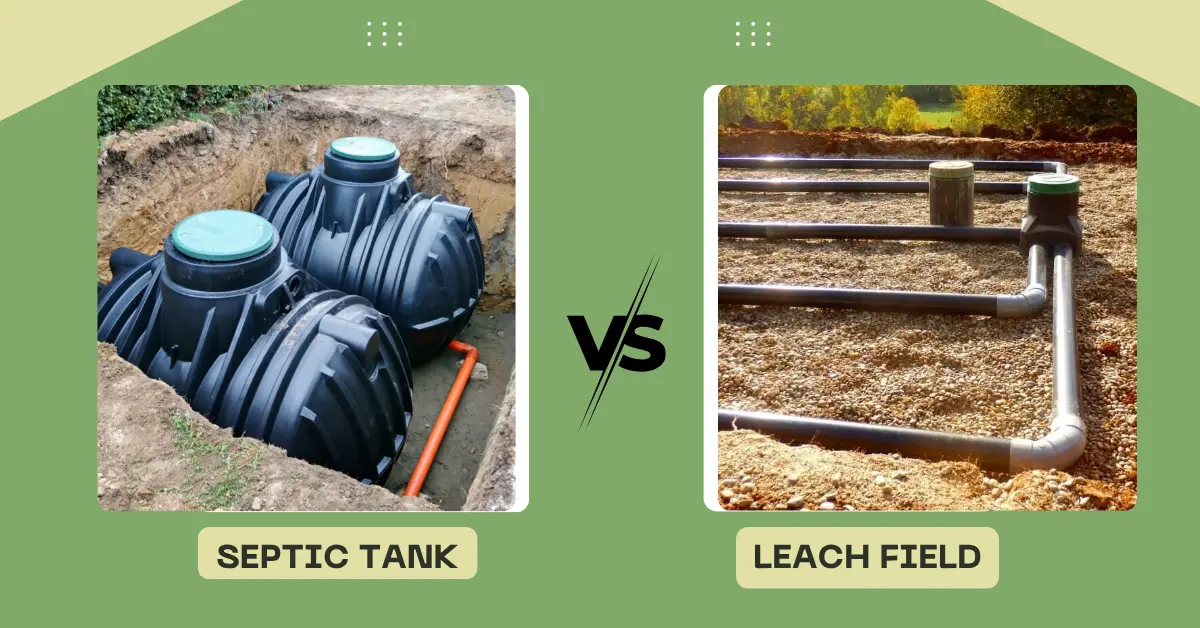
A septic tank is a watertight underground container designed to treat and manage wastewater from homes that are not connected to a municipal sewer system.
It plays the first critical role in a septic system by separating solids from liquids and beginning the breakdown of organic material.
How a Septic Tank Works?
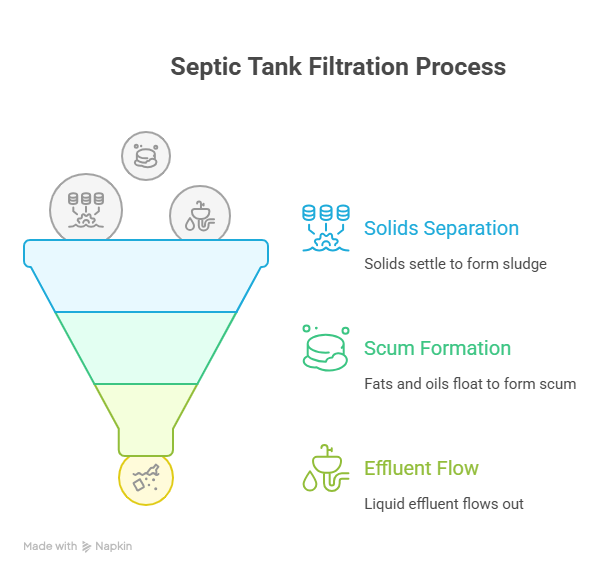
When wastewater flows from your home into the septic tank, the treatment process begins. Here’s a detailed guide on how a septic tank works.
- Solids sink to the bottom and form a layer of sludge.
- Fats, oils, and grease float to the top, which forms as a scum layer.
- The liquid layer, called effluent, remains in the middle and flows out of the tank into the leach field for further treatment.
Anaerobic bacteria inside the tank naturally break down the solids. It slows the accumulation and reduces odors.
Most tanks have two compartments to improve efficiency, and T-shaped inlet/outlet pipes prevent solids from escaping and clogging downstream components.
Common Materials Used
Septic tanks are typically made from one of three materials.
- Concrete – Durable and long-lasting, but heavy and can crack over time if not properly installed.
- Fiberglass – Lightweight, non-corrosive, and resistant to cracking, though more costly upfront.
- Plastic (Polyethylene) – Affordable, rust-proof, and easy to install, but may be prone to shifting or damage if not correctly backfilled.
Tank Sizes and Typical Residential Use
The size of a septic tank depends on household size, water usage, and local regulations. Most residential homes use tanks between 750 and 1,500 gallons. Here’s a quick overview:
- 750 – 1,000 gallons: Suitable for smaller homes with 1 – 2 bedrooms.
- 1,200 – 1,500 gallons: Ideal for medium to large homes (3 – 5 bedrooms).
- Larger tanks: Required for multi-family properties or homes with high water usage.
Proper sizing is essential to ensure the tank holds wastewater long enough for solids to settle and bacteria to work effectively.
Maintenance Needs
Proper maintenance is essential to keep your septic tank functioning smoothly. Usually, tanks should be pumped every 3 to 5 years to remove accumulated sludge and scum.
Ignoring this can lead to serious problems such as backups, foul odors, or system failure. Be alert for warning signs like slow drains, sewage odors near the tank or yard, or soggy patches above the leach field.
Routine inspections and pumping usually cost between $250 to $500, based on location and tank size.
Leach Field – The Secondary Treatment Zone
A leach field, also known as a drain field, absorption field, or leach bed, is a vital component of a septic system that safely disperses and treats the liquid effluent (wastewater) from your septic tank.
After waste settles in the septic tank, the leftover liquid (effluent) flows into the leach field. There, it gets filtered and cleaned naturally by the soil before safely returning to the environment.
How Does a Leach Field Work?
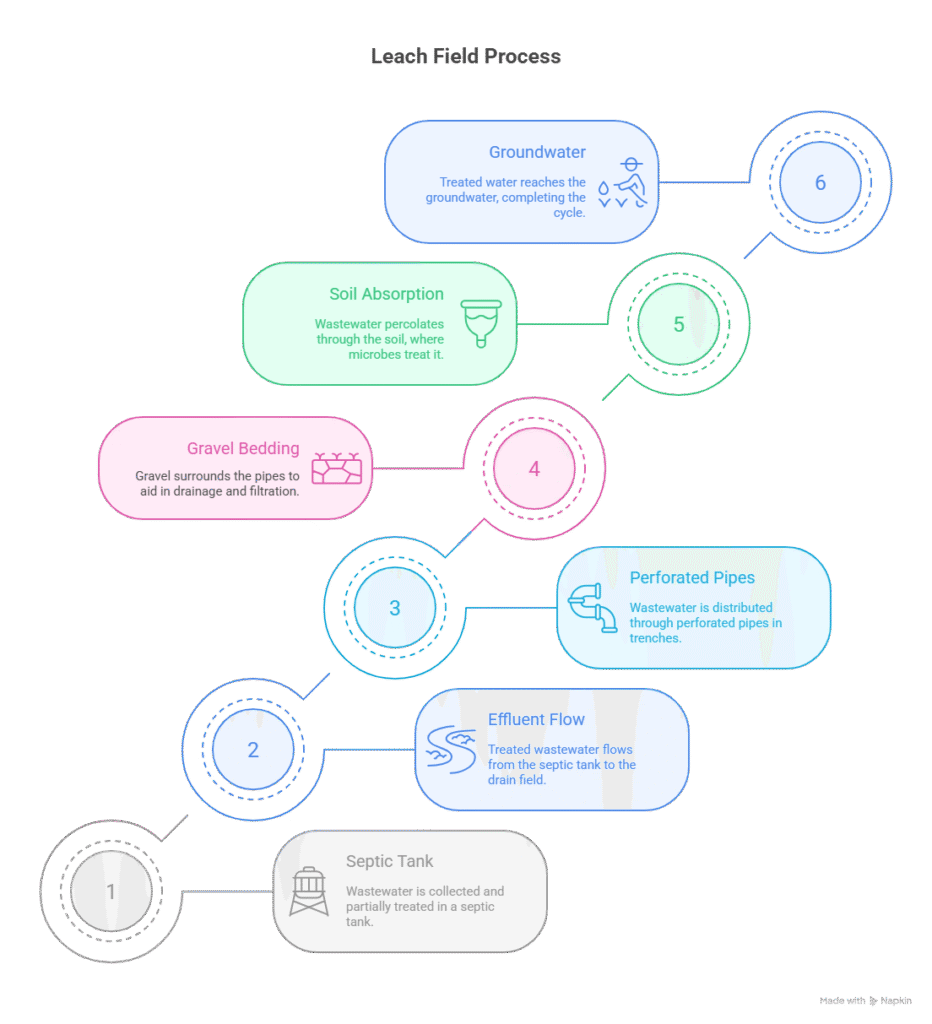
After wastewater solids have settled and been partially treated in the septic tank, the remaining liquid effluent flows by gravity into the leach field. The perforated pipes evenly distribute this effluent into the trenches.
As the liquid seeps through the gravel and then the soil, natural processes take over. The soil filters out harmful bacteria, viruses, and nutrients, while naturally occurring microbial action breaks down any remaining organic matter.
This two-step biological and physical filtration ensures the effluent is safely treated before it percolates into the groundwater.
Components of a Leach Field
Key elements of a leach field include,
- Distribution Box: Directs effluent from the septic tank into the leach field pipes.
- Perforated Pipes: Allow effluent to flow into the soil.
- Gravel or Aggregate Material: Provides structural support and facilitates even distribution.
- Soil: Filters and treats the effluent biologically and chemically.
Design & Maintenance
Proper design and maintenance are critical for a healthy leach field. This begins with correct sizing, which depends on factors like soil type, household wastewater volume, and local regulations.
A percolation test (or “perc test”) is often performed to measure how quickly water drains through the soil, guiding the size and layout of the system.
Leach fields can fail if exposed to soil compaction (from heavy machinery or vehicles), invasive tree roots, or excessive water use that overloads the system. These problems can lead to pooling wastewater, foul odors, and costly repairs.
On average, a well-maintained leach field lasts between 20 to 30 years. Signs that it might need replacement include persistent soggy areas in the yard, slow-draining fixtures, or sewage odors.
Key Differences Between Septic Tank vs Leach Field
Knowing how each functions, where they are located, and how to maintain them can save you time, money, and stress down the road. Let’s have a look at the quick side-by-side comparison table.
| Feature | Septic Tank | Leach Field |
| Purpose | Primary treatment of wastewater | Dispersal and filtration of effluent |
| Location | near the home | Usually downhill from the septic tank |
| Key Process | Separates solids, scum, and liquids | Distributes and filters liquid effluent |
| Maintenance | Requires regular pumping every 3-5 years | Needs soil care, avoiding compaction and overload |
| Cost | Moderate (pumping and inspections) | Higher if replacement or repairs are needed |
Now, let’s have a detailed look.
1. Location
Septic Tank: Buried underground, close to the house, to receive wastewater directly from the plumbing system.
Leach Field: Located downhill or away from the septic tank to facilitate gravity flow. Often in the yard, with trenches or beds filled with gravel or other materials.
2. Function
Septic Tank: Acts as the primary treatment unit. It receives all household wastewater, separates solids from liquids, and begins the anaerobic breakdown of organic matter.
Leach Field: Serves as the secondary treatment zone. It disperses and further filters the liquid effluent from the septic tank into the soil. It allows natural processes to purify the water before it re-enters the groundwater.
3. Signs of Failure
Septic Tank: Water or sewage backing up into the home. Sometimes, there will be drains gurgling or draining slowly. In addition, foul smells are near drains or the septic tank area. There’s a presence of sewage odors around the septic tank or drain field.
Leach Field: Puddles or wet spots over the leach field area. You’ll see unusually green and spongy grass over the drain field, even during dry weather. Sewage odors emanate from the leach field area.
4. Maintenance Needs
Septic Tank: Requires regular pumping every 3 to 5 years to remove accumulated solids (sludge) and scum. It also needs periodic inspections to check for leaks, cracks, or other issues.
Leach Field: Avoid compacting the soil above the leach field and prevent tree roots from infiltrating the area. In addition, limit excessive water usage to prevent overloading the system.
5. Lifespan and Replacement
Septic Tank: With proper maintenance, a septic tank can last 20 to 30 years. However, neglecting maintenance can lead to costly repairs or replacements.
Leach Field: Generally lasts 15 to 25 years, but can extend up to 50 years with proper care. Signs of failure include slow drainage, flooding, or groundwater contamination.
How Septic Tanks and Leach Fields Work Together?
Wastewater begins its journey inside your home, flowing through pipes directly into the septic tank.
In this underground chamber, solids settle to the bottom as sludge, while lighter materials like grease and oils float to the top as scum. Then, beneficial bacteria break down these solids, starting the essential treatment process.
Once the solids have separated, the partially treated liquid, called effluent, flows from the septic tank into the leach field.
The leach field consists of a network of perforated pipes buried in gravel-filled trenches that evenly distribute this effluent into the surrounding soil. Here, natural filtration and microbial action further purify the water before it safely returns to the groundwater.
The septic tank and leach field must function in sync to keep your system working efficiently. If the septic tank is not maintained and solids overflow into the leach field, it can clog the soil and cause system failures.
Likewise, if the leach field becomes compacted, waterlogged, or obstructed by roots, it will fail to properly absorb and treat the effluent. It can result in pooling water, unpleasant odors, or backups.
Together, these components provide a two-stage treatment system: the septic tank performs primary treatment by separating and breaking down solids, while the leach field completes secondary treatment by dispersing and filtering the liquid effluent.
Can You Have One Without the Other?
In most traditional septic systems, the septic tank and leach field work as a pair. The septic tank’s role is to separate and partially treat wastewater, but it cannot dispose of the liquid effluent safely on its own.
That’s where the leach field comes in, filtering and dispersing that liquid into the soil. Without a leach field, the system can back up, contaminate groundwater, or fail altogether.
However, there are alternative wastewater solutions designed for specific situations where a leach field might not be feasible.
For example, holding tanks temporarily store wastewater until it can be pumped out and treated elsewhere, while mound systems elevate the leach field above the natural soil when conditions are poor.
Aerobic treatment units add oxygen to speed up wastewater breakdown. It’s important to remember that local laws and environmental regulations heavily influence which systems are allowed.
Many jurisdictions require a properly designed and permitted leach field as part of a septic system to protect public health and the environment.
Common Problems & Signs of Failure
Identifying early warning signs from both the septic tank and leach field can help you avoid expensive repairs or complete system failure.
Septic Tank Issues
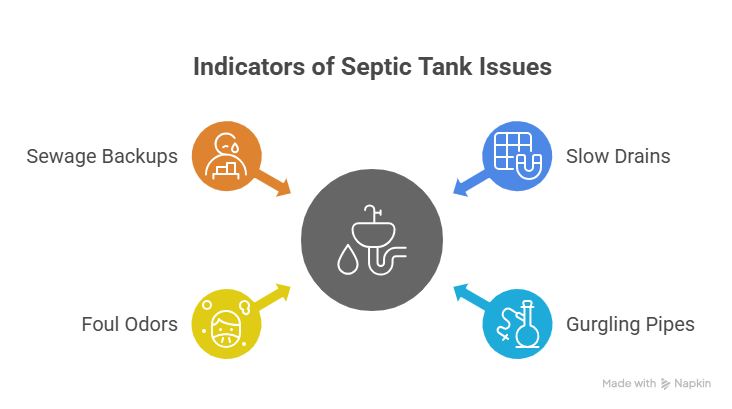
1. Slow Drains Throughout the House
If sinks, showers, and toilets are draining slowly, it’s often a sign that your septic tank is nearing capacity or there’s a clog in the line.
Solution: Schedule a professional inspection and consider pumping the tank if it hasn’t been done within the last 3 – 5 years.
2. Gurgling Sounds in Pipes
Strange noises after flushing or draining may indicate a backup forming within the tank or connected pipes.
Solution: Have the tank checked for blockages and ensure the venting system is working properly.
3. Foul Odors Indoors or Near the Tank Area
Strong sewage smells are a red flag, usually caused by an overflowing tank or a leak.
Solution: Get the tank inspected for cracks or leaks and schedule a pump-out.
4. Sewage Backups into the Home
This is one of the most severe signs of failure. If wastewater starts backing up into your sinks, tubs, or toilets, your tank or drain line is likely overwhelmed.
Solution: Contact a septic professional immediately for emergency service.
Leach Field Problems
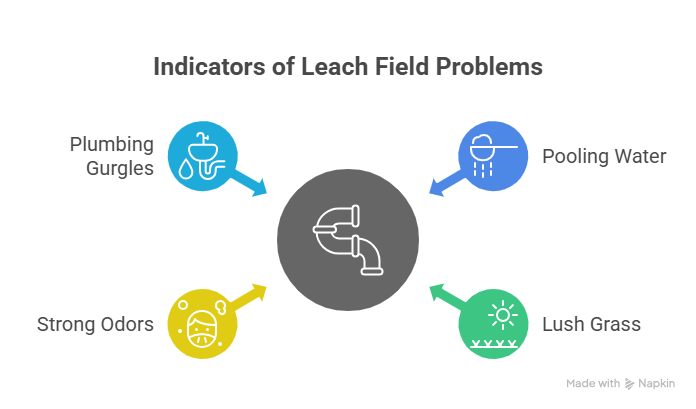
1. Pooling Water or Soggy Patches in the Yard
If the area over your leach field is wet or water is surfacing, your drain field may be clogged or oversaturated.
Solution: Limit water usage immediately and consult a septic expert to check for field saturation or pipe failure.
2. Lush, Green Grass Over the Leach Field
While it may seem like a good sign, overly vibrant grass often indicates a leaking or failing field where untreated wastewater is fertilizing the lawn.
Solution: Have the field assessed for uneven distribution or leaks.
3. Strong Odors Outside
Persistent sewage smells near the leach field signal that effluent isn’t filtering properly through the soil.
Solution: This could be due to soil compaction, tree root intrusion, or field age. Professional inspection is key.
4. Toilet or Plumbing Gurgles, Especially After Rain
Saturated soil can cause backflow pressure into your pipes, especially during or after wet weather.
Solution: Avoid using large amounts of water during these times and have your leach field checked for drainage problems.
FAQs
Is a leach field better than a septic tank?
Not exactly, because they serve different purposes. A septic tank handles the primary treatment by separating solids from liquids and beginning the breakdown of waste. The leach field provides secondary treatment by filtering and dispersing the effluent into the soil. Both are essential parts of a complete system and must work together to function properly.
How often do you need to pump a septic tank?
On average, a septic tank should be pumped every 3 to 5 years, based on the tank size, household size, and water usage. Delaying pumping can lead to sludge overflow, which can damage the leach field and lead to costly repairs.
How long does a leach field last?
A properly designed and maintained leach field can last 20 to 30 years or longer. However, factors like soil type, usage habits, and maintenance can significantly affect its lifespan. Early signs of failure include soggy ground, foul odors, or unusually green grass above the field.
Is it cheaper to be on septic or sewer?
In the long run, septic systems can be more cost-effective, as you avoid monthly sewer bills. However, they come with maintenance responsibilities like regular pumping and potential repairs. Sewer systems offer convenience but can be more expensive in urban areas due to connection and monthly service fees.
Can a septic tank function without a leach field?
No, a leach field is required for final wastewater disposal. However, alternative systems like holding tanks, mound systems, or aerobic treatment units may be used where leach fields aren’t possible, depending on local regulations.
What causes a septic tank or leach field to fail?
Common causes include infrequent pumping, grease buildup, tree root intrusion, soil compaction, or excess water usage. Both components are vulnerable if not properly maintained.
Can I build or park over a leach field?
No. Never build structures or drive vehicles over a leach field. It can crush the underground pipes, compact the soil, and drastically reduce filtration efficiency.
Wrapping Up: Which One Matters More?
When it comes to septic tank vs leach field, there’s no real competition; both are vital pieces of your home’s wastewater treatment.
The septic tank starts the process by separating and breaking down solids, while the leach field completes it by safely filtering and dispersing the treated liquid into the ground.
Neglecting one can cause the other to fail. That’s why regular pumping, careful water use, and routine inspections are essential to keep everything running smoothly for decades.
A healthy septic system isn’t just a convenience; it protects your property, your health, and the environment.
If you want to go deeper, check out related guides like Signs of Septic System Failure to stay ahead of problems before they start.
Flush smart, live clean!